Elections Results
Last update: October 21st 2026 at 2:31pm

The capstone is a rigorous learning opportunity for students to reflect and share in personally meaningful ways, and is a requirement for Career-Life Connections 12 and for graduation. The purpose of the capstone is for students to demonstrate the knowledge, competencies, and passion(s) that they can offer the world, as they integrate personal interests and strengths with preferred future possibilities.
A capstone project is a celebration of learning and experience. It is designed to encourage students to think critically, solve challenging problems and develop skills. It is their venue to connect with the world outside of school and to demonstrate that they have the knowledge and ability to go on to further their education, enter the workforce, and/or operate their own business.
The purpose of the capstone is to let students demonstrate the knowledge, competencies, and passion(s) that they can offer the world. Students
Proposal/Mentor – The student will select a project idea and develop a Capstone Proposal (see myBlueprint for Capstone Proposal assignment). Students should review the proposal with parent(s)/guardian(s) for ideas and assistance. The proposal will be reviewed and approved by the Capstone teacher (ideally before any work begins). A student may choose to identify a mentor as part of their proposal.
Research and Execution (Strands) – The execution component of the Capstone. This is the making/doing portion of the project.
Presentation – In the final step of the Capstone process, the student will deliver a 5–10-minute presentation to the Capstone teachers and audience members of their choice. A video presentation is also appropriate in some instances (more info below).
Reflection – In addition to the above components, student will answer a series of reflection questions that describe and consolidate their experience. Please see guideline for the reflection questions below.
Career and Life Connections 12 is offered outside the timetable and is comprised of 3 interconnected facets that need to be completed for graduation in BC.
Students are asked to complete a series of activities through the myBlueprint Career Education software (www.myblueprint.ca/sd58). This learning is documented using an online student-built portfolio through the myBlueprint site which students create before leaving for the summer. Students use the same log in credentials as other district software to access their myBlueprint account.
Username: school email address ([email protected])
Password: “sd” followed by student number (example-sd12345678)
Students are expected to complete 30 hours of Career Exploration. This work will also be documented in the student’s myBlueprint digital portfolio. Career Exploration is individual to each student and their post-secondary pathway of choice. Consultation with the CLC 12 teacher is integral to developing a plan that best fits each student. There will be many Career Exploration opportunities provided throughout the school year, but students can develop their own independent plan as long as it has purpose and connects to their career goals.
The purpose of the capstone is to let students demonstrate the knowledge, competencies, and passion(s) that they can offer the world. Students create a capstone project through reflection of their learning journey and core competency growth, designing and assembling a representation of that learning, and showcasing their capstone to an appropriate audience. Capstone projects are individual to student strengths and interests and can take many forms but are ultimately a culminating project that should demonstrate significant time and effort on the part of the student. More information on the Capstone Project will be distributed to students over the course of the school year as they develop their project. But for those that wish to start early, please contact Mr. Andersen for details.
You may already know exactly what Capstone you wish to pursue or perhaps you’ve even started on one. If you have not, consider the following approach for brainstorming and selecting a topic. Remember, it should be something that you are passionate and excited about so that you will learn from the experience and have a great time doing it. The following steps are guidelines for brainstorming and selecting an exciting and interesting Capstone.
In this step, determine a general area(s) of personal interest and future career opportunities.
In this step, explore your general subject area to determine a specific area of interest
In this step, consider your access to resources. Do you have access to what you will need to complete your Capstone project? The Capstone should stretch your abilities and create new learning opportunities, but it should not stress you out because you can’t get access to the resources you need to complete it.
In this step, determine the best method to showcase the topic of your Capstone by reviewing the project types and examples below:
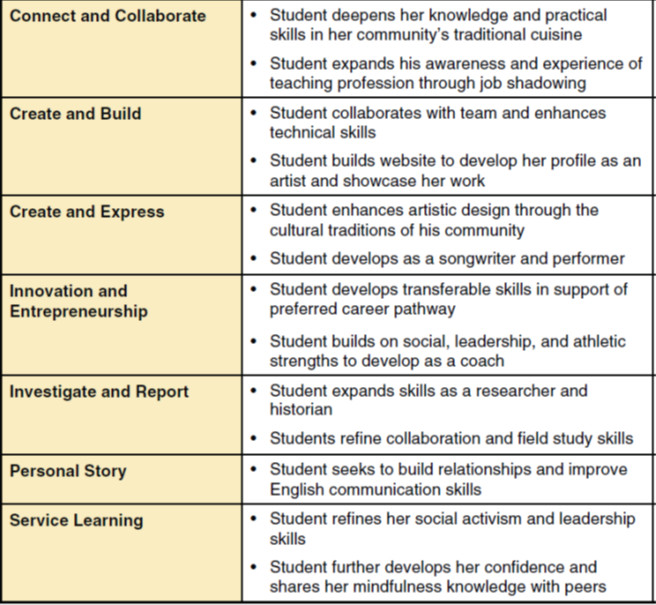
Consider the following:
Step 1: Healthcare
Step 2: Nursing
Step 3: Student has taken several science classes including Human Anatomy and Physiology 12 and enjoys helping and supporting others.
Step 4: Student spends time assisting an elderly family member with care (Service Learning).
Step 1: Architecture
Step 2: Modern Design and Construction
Step 3: Student has always enjoyed or been drawn to this particular design of buildings. Perhaps the student is an artist, or may have even taken classes where they have been introduced to design and build software.
Step 4: Designing and building a model of a small private residence using modern architecture design techniques. (Create and Build)
The final phase of the Capstone Project is the presentation. Your presentation will serve to further explain your project. In select circumstances, your presentation can be done via recorded video or live via virtual conference (Safety, necessary equipment cannot be brought to the school, student is at home due to enhanced COVID-19 risks). Please consider inviting your parents, mentor, or community individual to be part of your presentation if it can be done safely.
You should plan to explain your project to the attendees in 5 to 10 minutes in length. You should also be prepared to answer questions afterwards.
Appearance: you should be dressed appropriately for your presentation. Your dress and personal appearance are an important part of the presentation. It will show preparedness to enter the working world and is a part of the scoring rubric.
Whatever your method of presentation, you should begin by introducing yourself and your Capstone Project. Your goal is to provide the audience with a clear and concrete sense of what you did and what you gained from the experience.
The last requirement of the Capstone Project is to reflect on the process by answering 10 questions. These questions can be answered through the presentation itself, asked of you at the end of the presentation, or written and submitted to your myBlueprint Portfolio.
Required Questions: